

Optimizing Transaction Routing with Linear Programming
A side project exploring cost-minimizing vendor allocation under uncertainty.
When you process a large volume of transactions, you’re often not locked into a single vendor. Multiple vendors compete for your volume, each offering tiered pricing, volume commitments, and restrictions on which transaction types they’ll accept. The question becomes: how do you decide where to send each transaction to minimize cost while keeping everyone happy?
This post walks through a two-stage optimization approach to that problem, built using Google’s OR-Tools and a bit of statistics.
The Setup
The problem has a few moving parts:
- Vendors each have a minimum and maximum volume they’ll accept, and tiered pricing (the more you send, the cheaper it gets).
- Packet types are different categories of transactions, and not every vendor accepts every type.
- Forecasts for how many transactions of each type you’ll process are uncertain — you have a mean and standard deviation, not a hard number.
The goal: given a volume forecast, allocate transactions across vendors to minimize total cost, while satisfying vendor minimums/maximums and packet type restrictions.
Handling Forecast Uncertainty
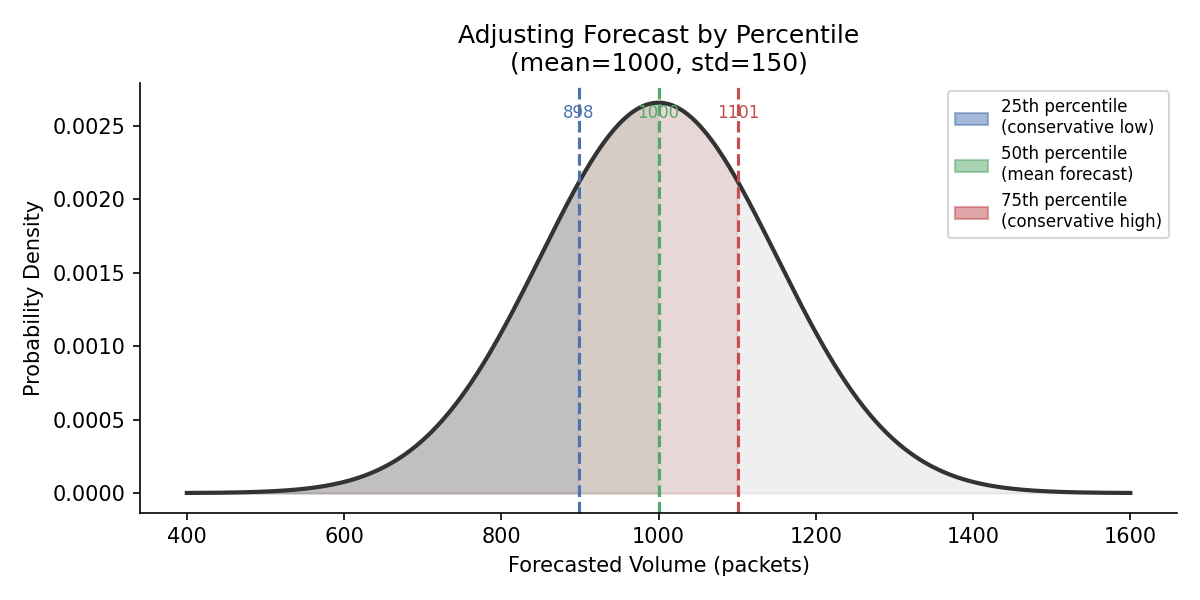
Before optimizing anything, you need a volume to plan against. The ForecastGenerator class handles this and includes a useful lever: rather than just using the mean forecast, you can adjust it to any percentile of the expected distribution.
def adjust_forecasts(self, adjustments: dict) -> None:
    for packet_type, percentile in adjustments.items():
        mean = self.forecast[packet_type]["mean"]
        std_dev = self.forecast[packet_type]["std_dev"]
        self.forecast[packet_type] = self._calculate_adjusted_forecast(
            mean, std_dev, percentile
        )

def _calculate_adjusted_forecast(mean, std_dev, percentile):
    z_score = norm.ppf(percentile)
    return mean + (z_score * std_dev)
So if you want to plan conservatively (protecting against higher-than-expected volume), you pass percentile=0.75 or 0.90. If you’re fine with the base case, use 0.50. This is a lightweight way to bake risk tolerance into the planning process without needing a full simulation.
Stage 1: Figuring Out How Much Goes to Each Vendor
The first optimization problem answers: given a total volume, how should we split it across vendors and tiers to minimize cost?
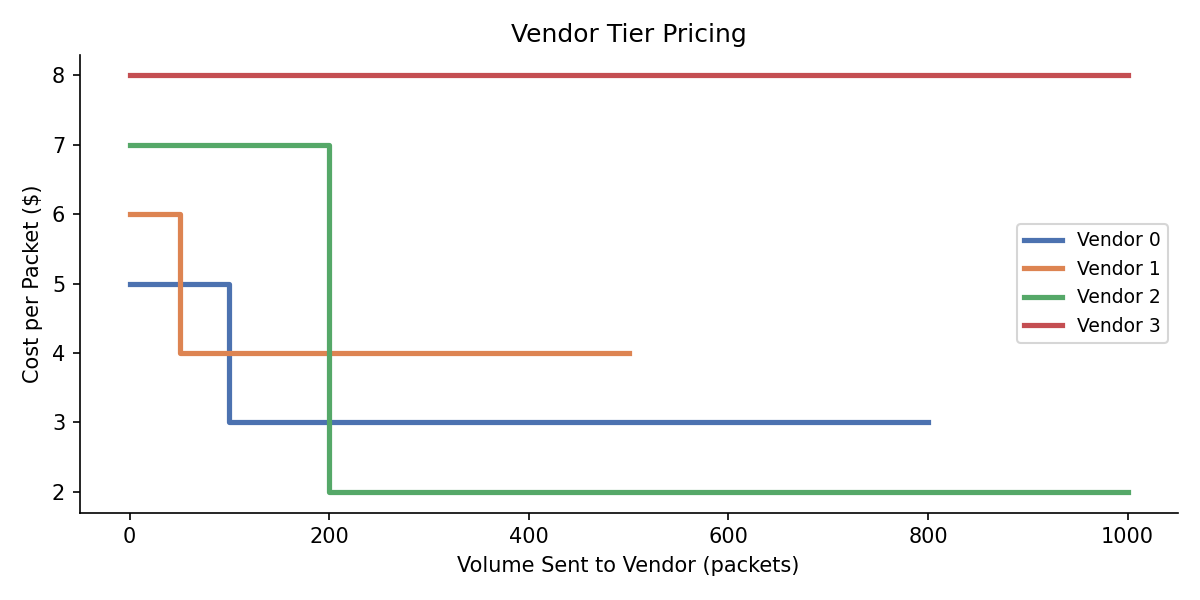
Each vendor has one or more pricing tiers. A tier kicks in after you’ve sent a certain volume — like a bulk discount. The trick is that tiers have to be filled in order; you can’t jump to the cheap tier without meeting the volume threshold for the cheaper tiers first.
Each vendor’s pricing structure looks like this — the solver is incentivized to push volume high enough to unlock the cheaper tiers:
This is a classic integer linear program. The decision variables are the number of packets assigned to each vendor at each tier:
x[vendor][tier] = number of packets at this tier
The objective is to minimize total cost:
minimize: sum over all vendors and tiers of (cost_per_packet[i][j] * x[i][j])
Subject to:
- Total packets shipped equals the forecast
- Each vendor stays within its min/max volume
- Tier volume constraints are respected (you can’t access tier 2 without filling tier 1 first)
Using OR-Tools’ SCIP solver, this resolves quickly even with several vendors and tiers. A sample run with four vendors and 1,200 total packets looks like:
Vendor 0:  Tier 1: 130 packets
Vendor 1:  Tier 1:  50 packets
Vendor 2:  Tier 1: 1000 packets
Vendor 3:  Tier 0:  20 packets
Total cost = 2750.0
The solver naturally gravitates toward Vendor 2’s deep-discount tier since it has the lowest per-packet cost once the volume threshold is met.
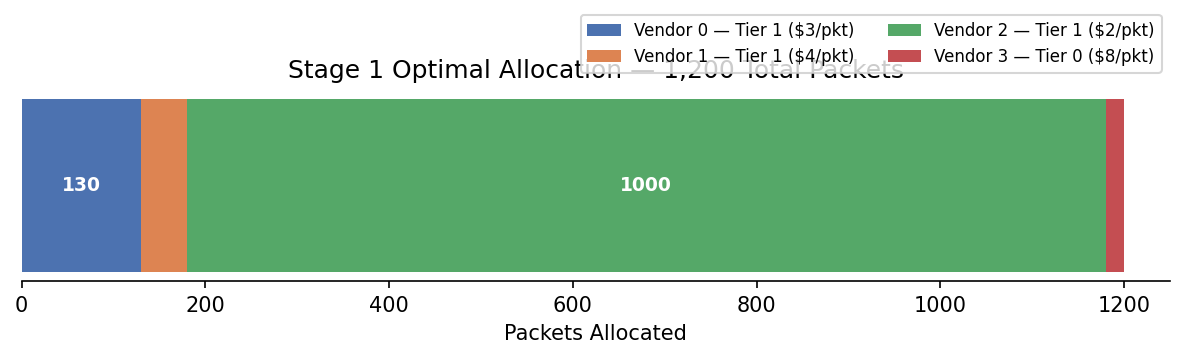
The output from this stage isn’t just volumes — it’s also the effective cost per packet for each vendor, which becomes the input to Stage 2.
Stage 2: Routing Each Packet Type
Now comes a subtler problem. Not all packet types can go to all vendors. So knowing “send 1,000 packets to Vendor 2” isn’t enough — you need to know, for each packet type, what fraction to route where.
The PacketRouteOptimizer solves this. Decision variables are the routing fractions:
x[packet_type][vendor] = fraction of this packet type sent to this vendor
If a vendor doesn’t accept a packet type, its variable is locked to 0. Otherwise it’s a continuous variable between 0 and 1.
The objective is again cost minimization:
minimize: sum over all packet types and vendors of
          (volume[packet_type] * cost[vendor] * x[packet_type][vendor])
With constraints that:
- Every packet type’s fractions sum to 1 (all packets get shipped)
- Each vendor receives at least its minimum committed volume across all packet types
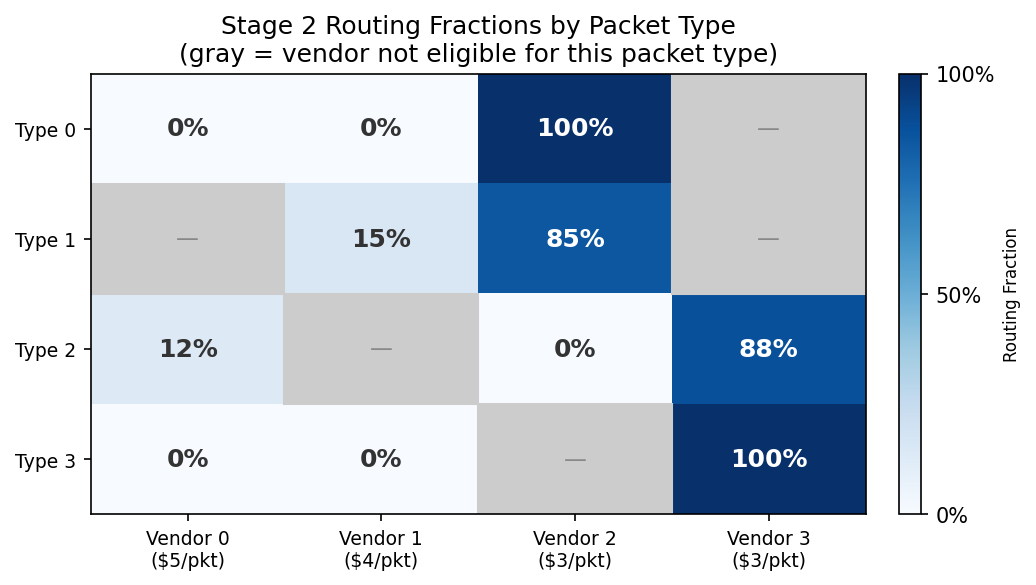
A sample result with four packet types and four vendors:
Package Type 0:  Vendor 2: 100.00%
Package Type 1:  Vendor 1: 15.00%,  Vendor 2: 85.00%
Package Type 2:  Vendor 0: 12.50%,  Vendor 3: 87.50%
Package Type 3:  Vendor 3: 100.00%
Total cost = 4030.0
The solver routes as much as possible to the cheapest eligible vendor for each packet type, then uses secondary vendors only as much as needed to satisfy commitments.
Translating Fractions to Runtime Routing
The optimization outputs fractions — but at runtime, when a transaction arrives, you need to make a concrete routing decision. The VendorRouter handles this using a cumulative probability approach.
def _prepare_cumulative_fractions(self) -> None:
    cumulative_fractions = []
    cumulative_vendors = []
    fraction = 0
    for vendor, v_fraction in self.vendor_fractions.items():
        fraction += v_fraction
        cumulative_fractions.append(fraction)
        cumulative_vendors.append(vendor)

def get_vendor(self, fraction: float) -> Vendor:
    for i, cum_fraction in enumerate(self.cumulative_fractions):
        if fraction <= cum_fraction:
            return self.cumulative_vendors[i]
    return self.cumulative_vendors[-1]
You pass in a random float between 0 and 1 (from a hash of the transaction ID or a random draw), and it maps to the appropriate vendor based on the cumulative distribution. For the example above where Vendor 2 gets 85% of Package Type 1: any draw below 0.15 goes to Vendor 1, anything else goes to Vendor 2. Clean and deterministic if you use a hash.
How It Fits Together
The full pipeline looks like this:
- Forecast — load mean/std_dev forecasts per packet type and adjust to your desired percentile
- Price tier optimization — find the optimal vendor volume split to minimize cost, accounting for tiered pricing and commitments
- Route optimization — given per-vendor costs and per-packet-type restrictions, find the fractional routing that minimizes cost while meeting vendor minimums
- Runtime router — load the fractional routing into a
PacketRouterand use it to make live routing decisions
The two optimization stages are deliberately separate. Tier pricing depends only on total volume per vendor. Routing fractions depend on per-packet-type restrictions and the per-vendor cost outcomes from Stage 1. Decoupling them keeps each problem tractable.
Wrapping Up
This was a fun use case — it sits at the intersection of forecasting, combinatorial optimization, and systems design. OR-Tools made the LP formulation straightforward, and the stats-based forecast adjustment adds a practical handle for managing risk without overcomplicating the model.
A few obvious directions to extend this:
- Multi-period optimization: run this weekly or monthly and account for volume rollover across periods
- Stochastic programming: instead of picking a single percentile, optimize over a distribution of forecast scenarios
- Dynamic repricing: re-optimize routing mid-period if actual volume deviates significantly from forecast
The code is available on GitHub if you want to dig in.